Friday, October 14, 2016

2016 Flagstaff to Grand Canyon Stagecoach Line 
100 Miles Across Northern Arizona 
by Race Director Ian Torrence 


The Flagstaff to Grand Canyon Stagecoach Line unfolds like a good story. Like any addictive page-turner, the event establishes its characters, puts them through hell but ultimately leaves each participant with a newfound sense of introspection and grasp on what they can truly accomplish.

Morning on the mountain 

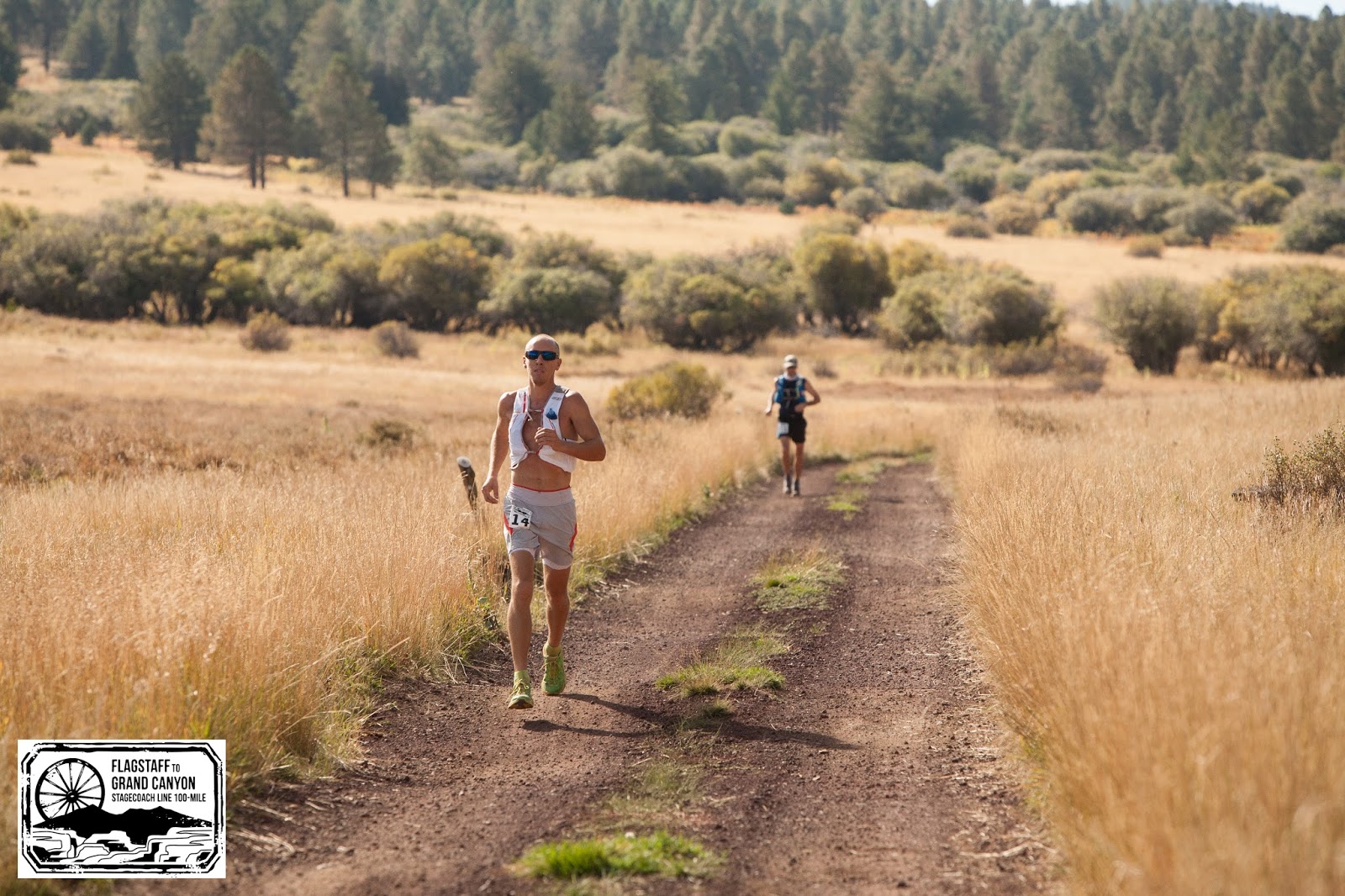
Stagecoach’s 100-mile, 55K and relay races begin in a wide meadow at the base of the San Francisco Peaks, Arizona’s highest mountains, near the Flagstaff Hotshots facility. In this year’s 55K event, Flagstaff’s Jim Walmsley, two-time winner of the JFK 50 Mile, took a commanding lead on the initial five-mile climb to 9000’ on the Arizona Trail.


Tucson’s Sion Lupowitz, second at last year’s Mogollon Monster 100 Mile, did the same in the 100-mile distance. Katie McGee, a 2005 USATF World Cup 100K team member, copied form in the 55K event by cruising through the high altitude aspens well ahead of all but Walmsley and southern Arizona speedster Catlow Shipek, last year’s Old Pueblo 50 Mile winner. It was clear that as the runners passed through the race’s first aid station at The Nature Conservancy’s Hart Prairie Preserve the women’s 100-mile race would be a battle between Kelly Nicholas and Holly Hovious, both newbies at the 100-mile distance.


After passing by idyllic Bismark Lake, mile 13, runners descend 2700’ in 20 miles on single track and two-track trails through aspen, spruce, fir, ponderosa and finally into pinion-juniper rangeland. At Cedar Ranch, mile 33, the 55K race ends. Walmsley set a new course record in 3:30:44 averaging a blistering 6:15/mile pace. Shipek would finish second in 4:19:10 and John Mollenhour would finish third and win the master’s division in 5:17:06. On the women’s side, McGee would capture the win and set a new course record in 4:37:00. Alyson Jay would collect second overall in 5:45:02 and Margaret Montfort, like Mollenhouer, would finish third and take home the women’s master’s title in 6:07:31.

In the 3-person 55K relay, Team Prent, consisting of Andrew Ned, Keith Vicente and Brandon Kescoli, finished with the fastest time in 5:34:04. 100-mile runners and relays still had many miles to travel and continued north towards the Grand Canyon.

The middle miles on the ranch 

Babbitt Ranches, the title sponsor of the Stagecoach races, prides itself on three cornerstone fundamentals: character, nature and community. One can see why the fit between ranch and race is both seamless and logical. Participants traverse Babbitt’s for 20 miles. Locations like Cedar Ranch, Tub Ranch and Oil Line serve as aid station oases for runners as they cross one of the largest ranches in the United States.


This expanse is, perhaps, the toughest portion of the course as night falls and temperatures begin to drop. Lupowitz, unfazed by the setting sun, built on his lead in the 100-mile race. Nicholas and Hovious continued to duke it out as they sidestepped cattle, horses and antelope under clear star-riddled skies en route to race distances they’ve never covered before. This year, forty-one 100-mile starters and 8 relay teams would press forward, through Babbitt Ranches, towards the finish.

The final push across the Kaibab to the finish 

Near mile 55 runners enter the Kaibab National Forest and leave the dirt roads of Babbitt Ranches for the lesser traveled single-track of the Arizona Trail. Here, at Boundary Aid Station, bugling elk and the distant coyote howl isn’t uncommon. At Moqui Aid Station, near mile 60, runners rest at the same location 1890s stagecoach trips bound for the Grand Canyon would stop to water their horses. After passing under the old-growth ponderosa stands near Russell Tank, mile 68, participants traverse the Coconino Rim, a long 12-mile limestone cliff rich with archaeological history. During the 500’ descent to historic Hull Cabin, which also serves as the 80-mile aid station, runners can catch a glimpse of the Grand Canyon. However, if acrophobia doesn’t deter, one can get a better view by climbing a few landings of the Grandview Fire Tower, near mile 82. Jaw dropping views of the Canyon, two miles distant, can be used to build inspiration for the final push to the finish.


Stagecoach ends in the in the small Grand Canyon National Park gateway town of Tusayan, just north of the Grand Canyon Visitor Center and IMAX Theater. Lupowitz would hold onto his lead and win in 17:42:17, the third fastest time in Stagecoach’s four-year history.


Flagstaff’s Buck Blankenship would avenge last year’s DNF by finishing second in 20:49:18 and Wayne Williams, in his first hundred-mile attempt, would finish third in 21:45:30.

Kelly Nicolas would pull ahead of Holly Hovious during the tough night hours for the win in 24:36:59 to Hovious’ 25:12:10.


California’s Kara Teklinski methodically moved through the pack to finish third woman and take the masters title in 26:54:50. Twenty-nine 100-mile runners completed this year’s event.


The 2-person team, Mad Bruins, would win their relay category in 17:12:49. The 6-person team, Phoenix Free Soles, would dominate the entire field by finishing in a speedy 12:44:52, three minutes slower than the record set by Team RunFlagstaff in 2013. The 8-person team, Running Amuk, would win their category in 18:28:28. Next year’s race will be held on September 23-24, 2017. We’re already looking forward to putting together another storybook masterpiece.

Wednesday, May 11, 2016

Toughest 50 Mile: Zane Grey vs. Wapack and Back

Most ultrarunners haven't even heard of this race.  However, this still doesn't make it an easy event to get into.  You have to be waiting by the computer when registration opens and hope you're one of the first 30 to hit the proper key strokes.  The planets aligned this year and I was able to both register in time and make the trip east for the 10th running of the Wapack and Back 50 Mile.  This is an event that I've wanted to do for some time due to its acclaimed difficulty (more on that later), trail history and location.

The setting for the Zane Grey 50 Mile - The Mogollon Rim.

The setting for the Wapack and Back 50 Mile - The Wapack Range

The race course travels the length of the Wapack Trail (21.4 miles from north-central Massachusetts to southern New Hampshire) one of the oldest interstate hiking trails in the US.  The race does an out-and-back on the trail, then heads out for another "short" 7-mile out-and-back to collect the total mileage.  There's an accompanying one-way (21.4 miles) event held as well that has double the participant numbers.

I was really interested in how this race would stack up against another difficult 50 mile event that I enjoy participating in: the Zane Grey 50 Mile.  Zane follows the entire length of the Highline Trail #31, a National Recreation Trail, and a portion of the Arizona Trail.  The point-to-point race contours below a 200-mile long "cliff" called the Mogollon Rim in east-central Arizona from Pine to near Christopher Creek.  Two weeks before Wapack, I finished my 13th Zane, a race that's been held for 27 years.

I know of only two other runners (new update: three) who have completed both events.  Bret Sarnquist, who now hails from Silver City, New Mexico, ran and won Wapack (his first 50-mile race in 2008) in 9:57, still one of the 10 fastest times on the course.  He's run Zane five times. Deb Livingston, the race director of the Soapstone Mountain Trail Races, has run Wapack three times (including two victories and the second fastest time on the course) and has finished Zane once. You'll hear their voices occasionally in this piece.  In 2007 New Mexico's Sean Cunniff finished Zane and Wapack in back-to-back fashion and then went on to complete San Juan Solstice 50 Mile almost a month later.

Bret Sarnquist at the 2016 Zane Grey.

Debbie Livingston at Wapack (with family and the author).  Photos by her husband Scott Livingston.

So, for those of you who are interested, let's break down two of the most difficult 50 mile races in the US.

1) Environment:  These races happen on two different sides of the country.  Wapack in the northeast, Zane in the southwest.  Wapack runs through forests of yellow birch, eastern hemlock, american beech, white pine, sugar maple and red oak.  Schist and granite make up the steadfast rocks found on  the course. Zane passes though ponderosa pine, pinyon and juniper forest.  The rocks underfoot consist of loose and eroding limestone and sandstone. Wapack is mostly tree covered but occasionally passes over barren rock-covered 2000'+ summits.  The Zane course runs between 5000' and 6500' and though some of the course has canopy, wildfires like the Dude Fire have left many miles of the course treeless.  Weather can be a wild card.  Zane is most likely to have warmer temps -- 70's with sunny clear skies.  However, how can we forget the snow storm of 2014 that cut the race short?  Wapack typically experiences wet, cloudy conditions, which make the rock slabs underfoot (which make up most of the course) very slippery.  However, according to Trail Animals Running Club race director Jesse Veinette, 2015 saw temps in the mid-80's.

Typical scenery in the middle of the Zane course - The remains of the Dude Fire.

Common Wapack footing.

2) Rocks:  Both of these races score high with a sh@t ton of rocks.  If you're looking for a smooth, flowing trail course you will not find it at either Zane or Wapack.  There is little rhythm running to be had in either at these races. Wapack rocks are large, in-place slabs set at precarious angles.  You'll need your hands!  Add moisture to the moss and lichens that cover these boulders and they become "slicker than snot on a door knob."  Pad your tail bone for this race.
Wet rocks and roots on the Wapack Trail.

Imagine someone dumping a truck full of babyhead-sized rocks in your front yard and then running up and down that pile for 9+ hours.  You now have a visual of the footing for most of the Zane course.  Ankle twisters and knee benders.

The words erosion and Zane are synonymous.

3) Terrain:  Wapack weighs in with roughly 11,500' of gain.  Zane pounds you with about 9,700' of vert.  Wapack's climbs are steep and relentless.  Some are so rocky (see boulder field), that even on fresh legs you must hike and climb.  Zane's ascents are much longer and drawn out.  Runnable on fresh/strong legs, but breathtaking due to the high altitude and exposure to the dehydrating sun.

Wapack's elevation profile.

Zane's elevation profile.

"What makes Wapack harder is the relentless elevation change combined with the technicality of the trails," says Sarnquist. "Zane has plenty of climbing, but Wapack is constant up and down - there's no break from the short climbs and descents and those tend to be steep, meaning walking both up and down. The technicality of the trails at Wapack limits your top speed. The trails at Wapack are more technical overall with some steeper grades, worse footing and some scrambling." 

"Zane Grey was challenging for me in 2012 due to the altitude and the heat," says Livingston. "The many rocky sections can be a pain but I don't think they slow you down as much as the boulders in Wapack and Back."

3)  Course Marking/Navigation:  Both courses meander ruthlessly with sharp twists and turns.  Lush vegetation along the routes can, at times, obscure proper footing and the trail itself.  Both events will leave vegetative cuts and scrapes on your legs and arms.  Because they are both historic trails they are marked with permanent markers: Zane with metal silver diamonds and Wapack with painted yellow triangles.  However, if you look down too long you'll quickly find yourself off course on either course.  Zane's race management flags the course.  At Wapack, they do not.

Wapack's yellow blaze.

Some of the tough trails to follow at Zane.

"I find the out-and-back format of Wapack to be mentally challenging, since you have to do everything again," laments Sarnquist.  "Every steep climb, mud pit, and overgrown section is something you'll have to deal with again."  

4) Distance:  Garmins aren't always accurate.  However, Wapack has always been the same course.  The trail hasn't changed significantly, except for a detour around the Windblown Ski Area, for 10 years.  On the other hand, Zane's course, even though the start and finish line haven't changed, (with the exception of one "reverse" year) is in a state of constant upheaval.  Erosion, vegetation growth and downed trees have added mileage to the course through the years.  Today, funding has been allocated to repair the Highline Trail.  Work parties with heavy equipment are making headway in realigning/rerouting the trail.  Great news, but this has added significant mileage to the course.  The Zane course now spans an additional 2-3 miles.  Expect this to grow in the next two years as trail repairs are completed.

Views from a bald Wapack summit.

Trails like this are quickly being replaced with new improved tread on the Zane course.

5) Aid:  Both courses rock in the support category.  Teams of dedicated volunteers at Wapack and Zane work tirelessly to keep all runners happy and moving forward.  However, Zane sports only five well-stocked aid stations (not including start and finish).  Wapack is able to provide welcomed assistance at nine locations.

Aid at mile 24 at Zane Grey.

A look at the tents that protect the aid stations at Wapack.

6)  Participation/Competition:  Zane has been around much longer than Wapack, and it was, at one time, part of the old Montrail Cup Series. This designation brought some of the most competitive ultrarunners to the venue for several years.  Runners like Dave Mackey (current course record holder at 7:51), Nikki Kimball (current record holder at 9:14), Geoff Roes (Western States 100 Mile winner), Darcy Piceu (Hardrock 100 mile winner), Kyle Skaggs (Hardrock 100 mile winner), Petra Pirc (Tahoe Rim Trail 50 Mile and San Juan Solstice 50 Mile winner), Karl Meltzer (Hardrock 100 mile winner), Kerrie Bruxvoort (Quad Rock 50 Mile and San Juan Solstice 50 Mile winner), Hal Koerner (Western States 100 Mile winner), Diana Finkel (Hardrock 100 Mile winner), Anton Krupicka (Leadville Trail 100 Mile winner) and Scott Creel (Tamalpa Headlands 50K winner) among others.  Now-a-days, Zane has nearly 150 starters.

Wapack, a younger race, a much less publicized event and local favorite, has a very small starting field due to the constraints of the Wapack Trail.  Josh Katzman (a top 20 finisher at Western States and PR of 15:35 for the 100-mile distance) holds the men's course record at 8:51 and Kristina Folcik (winner of Traprock 50K and 3rd at Leona Divide 50 Mile) holds the women's record at 10:53.  Other notable finishers include both Debbie Livingston and Bret Sarnquist.  Wapack has less than 30 starters each year.

7)  Entering: Entry to Zane is via a lottery that opens on October 1, 2016.  Wapack will, most likely, be on a first-come first-serve basis that might be opening on February 1st, 2017.  Better mark your calendars.


A lucky 13th finish at Zane.

My 1st Wapack finish and what I look like after two gnarly 50 mile finishes in 13 days.

In the end Sarnquist picks Wapack over Zane in terms of difficulty.  "People tend to underestimate the difficulty of races back east," he explains.  "Expectation is everything, as they say, and if you expect it to be not so bad some of those eastern ultras will be a real surprise."  But let's be honest, if we search hard enough we'll always find something bigger and harder. "Word on the street, or trail, is that the Tushars 93k is one of the hardest races around," points out Sarnquist. "Also up there, by reputation, are the San Juan Solstice 50 and anything in the Marin Headlands." 

Livingston also picked Wapack over Zane.   "In some respects Wapack and Back is a more challenging race due to the large rocks on many steep climbs along with lots of exposed roots," explains Livingston. "Add rain into the mix and that compounds that toughness. The other aspect that makes it hard to even complete is arriving at the finish with 7 miles to go. That makes the race mentally challenging and keeps many people from continuing on."

Cunniff, however, went with Zane as the tougher. "It was Zane for me, mostly because of the heat and exposure," he says. "But that nasty out-and-back at the end of Wapack definitely tested my mental toughness."

So, which race do I think is more difficult?  I'm not sure. As I recover from these two beastly courses I'm still trying to make up my mind.  What do you think?

Thursday, March 31, 2016

Five Questions with Desma Degraw - Interviews from the Flagstaff to Grand Canyon Stagecoach Line 100 Mile, 55K and Relays

Desma Degraw putting in the miles at the Stagecoach 100 Mile.

Sometimes you meet a person that makes finishing a 100-mile foot race look easy.  Not because they finish the race in course record time or win the event outright, but because of the journey they endured to get to the starting line.  Flagstaff resident Desma Degraw is one of these individuals.  Desma finished the 2015 Stagecoach, her first 100 mile, in 27:42:18.  I saw, firsthand, how determined she was to make her way to the finish.  However, her battle with cancer is the more inspiring story.  She shares:

"I was diagnosed with breast cancer in 2008 when I was 29 years old. I underwent neoadjuvant chemo, a double mastectomy with reconstruction and seven weeks of radiation. I had been a runner before my diagnosis (5K-1/2 marathon distance) but during my treatment I started marathon training. With Art's (her husband) help, running allowed me to take back my life and regain control. Even though, in the beginning, all I could do was jog/walk between light poles, every run I went on was a step toward health, a way of giving cancer the finger and kicking it out of my life. Besides, being bald meant I was more aerodynamic.

I'm now the front office manager for Arizona Oncology here in Flagstaff. It's a career that enables me to help others and pass along the kindness that I have experienced."

You can read, in detail, about Desma's Stagecoach adventures on her blog, here. She's also registered for the 2016 Stagecoach event.  We look forward to seeing her out there again as, perhaps, our first two-time finisher! We asked Desma to answer our five questions and this is what she said.

Art helps Desma get organized at Kelly Tank aid station.

1. Why did you choose Stagecoach?
"A few years ago, the Grand Canyon was the first stop on a trip to the West that my husband and I took to celebrate the culmination of my cancer treatments. Being able to run from our new home in Flagstaff to the Canyon was a way for me to reaffirm my continued good health and the commitment I've made to my running life as a way to show those who are currently facing cancer that things can be so much better when treatment is done. And, on a lighter note, it's so close to home that I didn't have to get up early." 

Sunset on Babbitt Ranch.

2. What was your favorite part of the course?
"My favorite part of the course was the wide open area between Tub Ranch (mile 38) and Oil Line (mile 45). I hit it just about sunset. Looking to the East, I could see the Peaks. Looking to the West, the world seemed to stretch away into the sunset. I was alone in that beautiful expanse. It was incredible." 

Typical Kaibab National Forest double track.

3. What was the biggest challenge Stagecoach presented?
"The biggest challenge was the race itself. It was my first 100 miler, and I was more than a little nervous in general. The part that gave me the hardest time was the stretch between Watson Tank (mile 88) and Reed Tank (mile 98). Fatigue and crankiness had set in along with some stomach issues. My sister sang to me and demonstrated her dance moves; both were very helpful. Then the kind young man at Reed gave us M&Ms which made everything better!"

Desma and Dara (Desma's sister and pacer) sharing quality trail time between dances.

4. What was your favorite aid station?
"My favorite aid station was Russell Tank (mile 68). There was some awesome thumping music and strobes lights guiding me in through the dark cold of the night. It was fantastic! And it helped that I got to pick up my pacer there, too!"

100 feet to go!

5. Three tips you can offer a Stagecoach first timer.
"Three tips I can offer are simple. Do your night runs. It became a little disconcerting in the wee hours of the morning. Put in the miles ahead of time. I was not as well-prepared as I though I was. Lastly, go into it planning to have fun! It is an incredible course, with phenomenal volunteers, cheerful fellow runners and a race director like no other." 

Savoring a job well done!

Bonus Question: Mt Humphreys or the Grand Canyon and why?
"I would have to choose the Grand Canyon. There is such a variety of trails. I love that I can run to the river, downhill, uphill and across the plateau. And I can get ice cream at the top!"

From here to there, as Desma's story shows us, "It's much more than just one foot in front of the other."

Monday, March 14, 2016

Five Questions with Michelle Hawk - Interviews from the Flagstaff to Grand Canyon Stagecoach Line 100 Mile, 55K and Relays

As mentioned in our last interview with Mark Hammond, the 2015 women's Flagstaff to Grand Canyon Stagecoach Line 100 Mile winner not only set a course record but she also placed second overall.  Michelle Hawk, from Tucson, Arizona, finished in a time of 19:08:39.  This is the fourth fastest time on the Stagecoach course and it also was the 26th fastest 100-mile time by a woman in North America in 2015. With successes in the 50K (wins at Elephant Mountain and the Hypnosis, Vertigo and Sinister Night Runs) and 50 mile (3rd at Old Pueblo) distances, Michelle picked Stagecoach as her 100-mile debut.  In preparation, she held her own Stagecoach training camp by covering the first and final 20 miles of the course in one weekend and attended the Flagstaff-based McMillan Running Trail/Ultra Training Camp. Like Mark and Suzanna Bon, Michelle was happy to share her race day experiences with us.

Michelle Hawk, #16, listens to last minute race day instructions.

Question #1: Why did I choose Stagecoach?

"I decided to run Stagecoach primarily because it was an easy travel distance from Tucson and I might be able to convince some friends to come up to crew and pace me."  

Michelle heading into Hart Prairie Preserve.

Question #2: What was your favorite part of the course?

"I actually have to pick two sections of the course as my favorite.  The section from Hart Prairie to Kelly Tank that took you through meadows and aspen groves were awesome.  That was some sweet single track.  Moqui Stage Station to Russell Tank provided me with an experience I will not soon forget.  The sun was setting and darkness came quickly.  Out of this darkness came the sounds of bugling elk." 

Michelle minutes outside of Cedar Ranch Aid Station.

Question #3: What was the biggest challenge Stagecoach presented?

"Having never run 100 miles before (58 being my longest day ever), the biggest challenge for me was mental, believing that I could run 100 miles.  The early miles seemed so easy and I kept worrying that the wheels were going to come off somewhere along the way."  

Michelle, post-race, with race director Ian Torrence (left) and race volunteers Scott Bajer and Ludo Pierson.

Question #4: What was your favorite aid station?

"Wow!  Favorite aid station?  Do I have to pick one?  Russell Tank, where disco lights, blaring music and pacers awaited.  Watson Tank, where I found the race director ladling out chicken noodle soup in the middle of the night.   Oil Line, cold grapes in middle of nowhere, boy did they hit the spot.  Awesome aid stations throughout the race!"

Michelle shows off her "Champion" belt buckle.

Question #5: Three tips you can offer a Stagecoach first timer.

"1.  Take it easy on all those easy downhill miles early in the race.  
 2.  Look around and revel in the awesome beauty all around you.  It changes again and again throughout the day.  
 3.  Chicken noodle soup is the 'BOMB' late in the race."  

Michelle, after her winning performance, at the finish line in Tusayan, AZ, with her crew and pacers.

Bonus Question: Mt. Humphrey's or Grand Canyon?

"Mt. Humphrey's only because I have never tackled it before."  

Bonus Question x 2: Would I pick Stagecoach again?

"FOR SURE!  Beautiful scenery!  Well marked course!  Awesome aid stations!  A FIRST CLASS event all the way around!" 

Thank you for sharing your story and photos with us Michelle!  Be sure to join us on September 24, 2016 at 8:00AM for the fourth annual Flagstaff to Grand Canyon Stagecoach Line 100 Mile, 55K and Relays.

Tuesday, March 8, 2016

Five Questions with Mark Hammond - Interviews from the Flagstaff to Grand Canyon Stagecoach Line 100 Mile, 55K and Relays

Mark Hammond, Stagecoach's 2015 men's winner and course record holder, cross-training like the champ he is.

In 2015, the Flagstaff to Grand Canyon Stagecoach Line 100 Mile saw course records in both the women's and men's race.  Mark Hammond, from Salt Lake City, Utah, became the fastest person to traverse the 100 mile point-to-point course in 17:37:25 (We'll meet the women's record setter in the next episode).  Incidentally, Mark's performance was also the 99th fastest 100 mile time in North America in 2015.  Mark came to Stagecoach just two weeks after his awesome third place 21:25:07 Wasatch Front 100 Mile finish.  Before that, Mark was fresh off wins at Squaw Peak 50 Mile, Skyline Mountain 50 Mile and the Tushar 93K Trail Run.  We caught up with Mark last week and he indulged us with his answers to five quick questions.

Enjoying the fruits of his labor.

Question #1: Why did you choose Stagecoach?

"I chose to run Stagecoach 100 just two weeks after running Wasatch 100 because I wanted to see how my body and mind would respond to another big effort with so little recovery time. I also wanted to explore the terrain around the San Francisco Peaks."

Mark, shirtless, at the start of last year's Stagecoach.

Question #2: What was your favorite part of the course?

"My favorite part of the couse was around mile 70 where I heard elk bugling all around me in the forest."

Mark nears the Hart Prarie aid station.

Question #3: What was the biggest challenge Stagecoach presented?

"The biggest challenge of Stagecoach was how flat the course is. I mostly race in steep terrain so my legs could have been better prepared for so much flat terrain."

Mark making strides on race day.

Question #4: What was your favorite aid station?

"My favorite aid station was the last one (Reed Tank) because I could see McDonalds from there."

Mark, post-race, talking with race director Ian Torrence.

Question #5: Three tips you can offer a Stagecoach first timer.

"My tips for a Stagecoach newbie are to do do lots of training on flat terrain, be ready for heat and bring an elk bugling tube to see if you can call an elk to you while running."

No need for a hotel room or tent.  A bag was all Mark needed after he crossed the finish line.

Bonus Question: Mt Humphreys or the Grand Canyon and why?

"Grand Canyon trumps Humphreys any day.  Because I can buy lemonade at the bottom of the Grand Canyon but not at the top of Humphreys."

Thank you Mark for taking the time to chat with us about your Stagecoach experience. If you haven't read our last interview with 2013 winner Suzanna Bon you can do that here. Be sure to join us on September 24th, 2016 at 8:00AM for the fourth annual Stagecoach Line 100 Mile, 55K and Relays.

Sunday, March 6, 2016

Five Questions with Suzanna Bon - Interviews from the Flagstaff to Grand Canyon Stagecoach Line 100 Mile, 55K and Relays

The inaugural Flagstaff to Grand Canyon Stagecoach Line race took place on October 19th, 2013.  We started the race at 2:00PM to take advantage of the full moon over the open lands of the Babbitt Ranches (miles 30 to 55).  Our first year had a small but stellar field, including one of the toughest ultrarunners from northern California, Suzanna Bon.  Suzanna came to Arizona sporting wins at the San Diego, Cascade Crest, HURT, Angeles Crest and Chimera 100 mile races, a top-10 finish at Western States, as victor of both the Lake Sonoma 50 Mile and Quad Dipsea and a 5th place at the 2012 World 24-Hour World Championships.  It wasn't surprising that she won the women's race and placed 4th overall in 21:01 at Stagecoach.  We recently reconnected with Suzanna and reminisced about her experience in northern Arizona.

Suzanna Bon (in yellow shirt, sunglasses and headband) listens to last minute pre-race instructions.

Question #1: Why did you choose Stagecoach?

"First, the timing worked well for me and my family. I was drawn to the historical nature of the course, I like a trail with a story. And last but not least - FLAGSTAFF!"
Suzanna with friend Tamara Buckley-Johnson minutes before the start.

Question #2: What was your favorite part of the course?

"I can’t choose just one section - I particularly enjoyed the sections from Kelly Tank all the way to Oil Line. The sun was setting, the colors and views were glorious with a full moon rising…a trail runner's delight. I also loved the forest section from Russell Tank to Hull Cabin - the dead of night, under the trees and a hanging full moon, running alone watching out for the Blair Witch!"


Suzanna approaching the first aid station at Hart Prarie.

Question #3: What was the biggest challenge Stagecoach presented?

"The cold night time temps - I was freezing and it was tough to leave the aid stations with their roaring fires. It was the first race I have ever run bundled in down, beanie, gloves, leggings etc- clearly, I simply wasn’t running fast enough."

Moqui Stage Station in day light hours.

Question #4: What was your favorite aid station?

"Moqui Stage Station, a very cool historical setting- I felt like a time traveller. This aid station had ambience! With the twinkling lights, hot food, roaring fire and supportive volunteers Moqui was a stand out."

 Suzanna collects her winnings: A congratulatory handshake from race director Ian Torrence, the Stagecoach "Champion" buckle and a Babbitt Ranches Pendleton blanket.

Question #5: Three tips you can offer a Stagecoach first timer.

"Warm clothes in drop bags. Bandana or buff to cover mouth/nose for dust protection. Don’t linger too long by the fire!"

Bonus Question: Mt. Humphreys or the Grand Canyon and why?

"Mt Humpherys. I know and love the canyon so would choose Humphreys for a new and unknown adventure."

Thank you, Suzanna, for coming to our little race and taking the time to answer our questions.  Join us this year on September 24th, 2016 at 8:00AM for the fourth annual Stagecoach Line 100 Mile, 55K and Relays.